
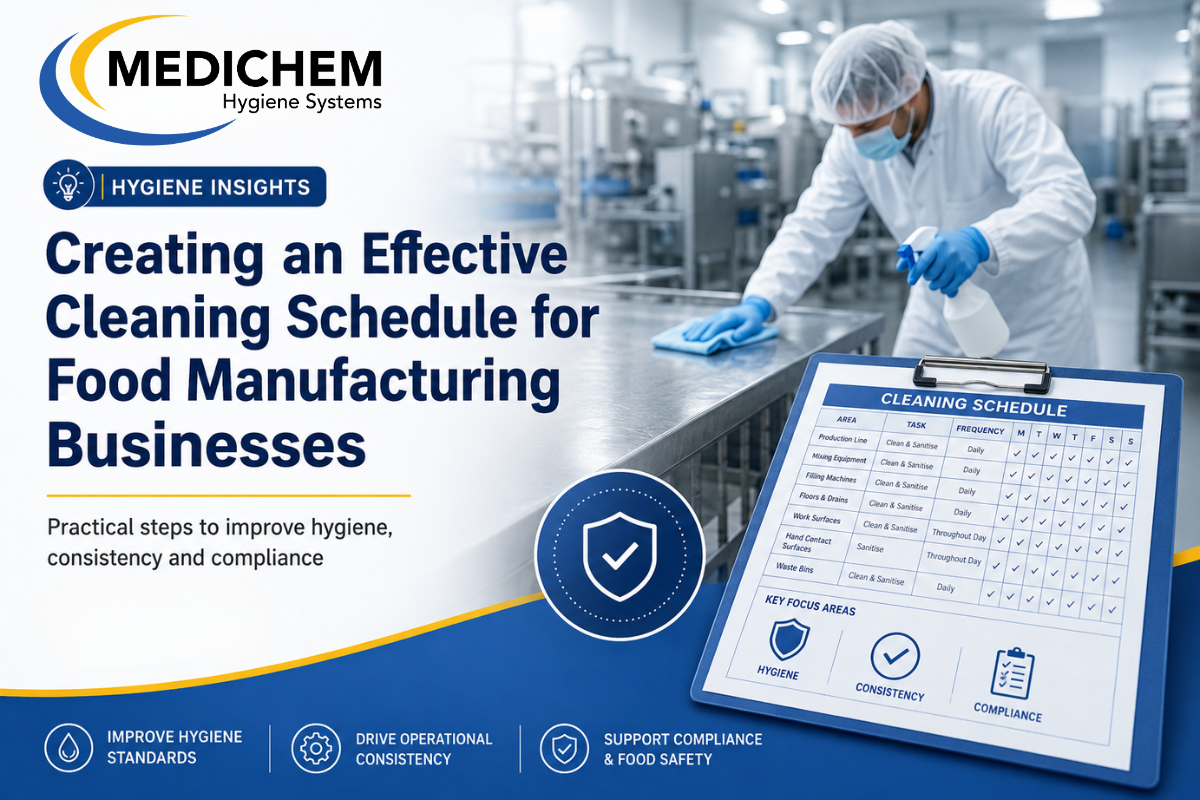
How to Create an Effective Cleaning Schedule for a Food Manufacturing Facility
In a food manufacturing environment, cleaning is not just a housekeeping task. It is part of the food safety system. A well-structured cleaning schedule helps reduce contamination risk, supports audit readiness, protects product quality, and gives staff clear instructions on what needs to be cleaned, how often, and by whom.
An effective cleaning schedule should be practical, easy to follow, and specific to the facility. It should reflect the type of food being produced, the equipment being used, the level of soil present, and the hygiene risks in each area.
1. Map out all areas of the facility
Start by listing every area that needs to be cleaned. This should include production areas, processing equipment, packing areas, storage areas, floors, drains, walls, waste areas, staff facilities, hand wash stations, chemical storage areas and external zones where relevant.
It is useful to divide the facility into hygiene zones, for example:
- Food-contact surfaces
- Non-food-contact surfaces
- High-risk production areas
- Low-risk production areas
- Dry storage areas
- Wet processing areas
- Staff facilities
- Waste handling areas
This makes the schedule easier to manage and helps ensure that important areas are not missed.
2. Identify high-risk hygiene areas
Not all areas carry the same risk. Food-contact surfaces, filling lines, cutting tables, utensils, mixers, conveyors, packing stations and drains in wet areas may require more frequent or more detailed cleaning than general floors or storage areas.
Special attention should also be given to areas where there is a risk of cross-contamination, allergen carry-over, microbial growth, or product build-up.
By identifying these higher-risk areas, cleaning resources can be focused where they matter most.
3. Separate cleaning from sanitising
One of the most common mistakes in food manufacturing hygiene is treating cleaning and sanitising as the same thing.
Cleaning removes visible dirt, grease, protein, product residue and other soil from a surface. Sanitising or disinfecting reduces microorganisms to an acceptable level.
A surface should generally be properly cleaned before it is sanitised. Applying a sanitiser onto a dirty surface may reduce its effectiveness, especially where organic soil is present.
A good schedule should clearly state when a surface must be cleaned, when it must be sanitised, and whether rinsing is required.
4. Choose the correct product for the task
The cleaning product should match the type of soil, surface, application method and hygiene requirement.
For example, a food factory may need different products for:
- General hard-surface cleaning
- Foam cleaning of walls, floors and equipment
- Crate and bin washing
- Degreasing
- Hand washing
- Hand sanitising
- Food-contact surface sanitising
- Drain and floor cleaning
- Equipment cleaning
The schedule should specify the product name, dilution rate, application method, contact time, and any rinse requirements.
This is also where documentation matters. SDS, TDS, NSF registration details where applicable, and clear usage instructions should be available to the relevant staff.
5. Set realistic frequencies
Cleaning frequencies should be based on risk and actual production conditions. Some tasks may need to be done during production, some at shift change, some daily, weekly or monthly.
For example:
- Food-contact surfaces may need cleaning and sanitising before use, between product changes, and after production.
- Floors in wet production areas may need daily or shift-based cleaning.
- Drains may require scheduled deep cleaning.
- Walls, doors and external equipment surfaces may be cleaned weekly or as required.
- Chemical storage areas should be checked regularly for leaks, expired stock and correct labelling.
The schedule must be realistic. If it is too complicated, staff will not follow it properly.
6. Assign responsibility
Every task should have a responsible person or role assigned to it. A cleaning schedule that simply says “clean daily” is weak. It should state who is responsible, what must be done, and where the task must be signed off.
This improves accountability and makes it easier for supervisors to check whether cleaning has actually been completed.
7. Include monitoring and verification
A cleaning schedule should not only say what must be cleaned. It should also include how cleaning will be checked.
Verification may include:
- Visual inspection
- Supervisor sign-off
- ATP testing where used
- Microbiological swabs where required
- Internal hygiene audits
- Corrective action records
- Review of cleaning records
These records are important during food safety audits and help prove that the cleaning system is being followed.
8. Train staff properly
Even the best cleaning schedule will fail if staff do not understand it.
Staff should be trained on:
- Correct product use
- Dilution rates
- Contact times
- PPE requirements
- Safe chemical handling
- Cleaning methods
- Rinse requirements
- Colour-coded equipment where applicable
- The importance of accurate recordkeeping
Training should be repeated when products, procedures, staff or production conditions change.
9. Review and improve the schedule
A cleaning schedule should not be a once-off document. It should be reviewed when there are changes in production, new equipment, audit findings, customer complaints, product changes or hygiene failures.
Regular review helps keep the schedule practical, relevant and aligned with the facility’s food safety requirements.
Conclusion
A good cleaning schedule gives structure to the hygiene system. It helps staff understand what needs to be done, reduces the risk of contamination, supports food safety audits, and protects product quality.
For food manufacturers, cleaning should be treated as part of the production process, not something that happens separately from it.
At Medichem, we assist food manufacturing customers with practical cleaning and hygiene support, including product selection, training, documentation, and cleaning schedule guidance. Our range includes NSF registered cleaning and hygiene products suitable for use in food industry environments when used according to their registered category and instructions.
Built for compliance. Trusted for performance.


