
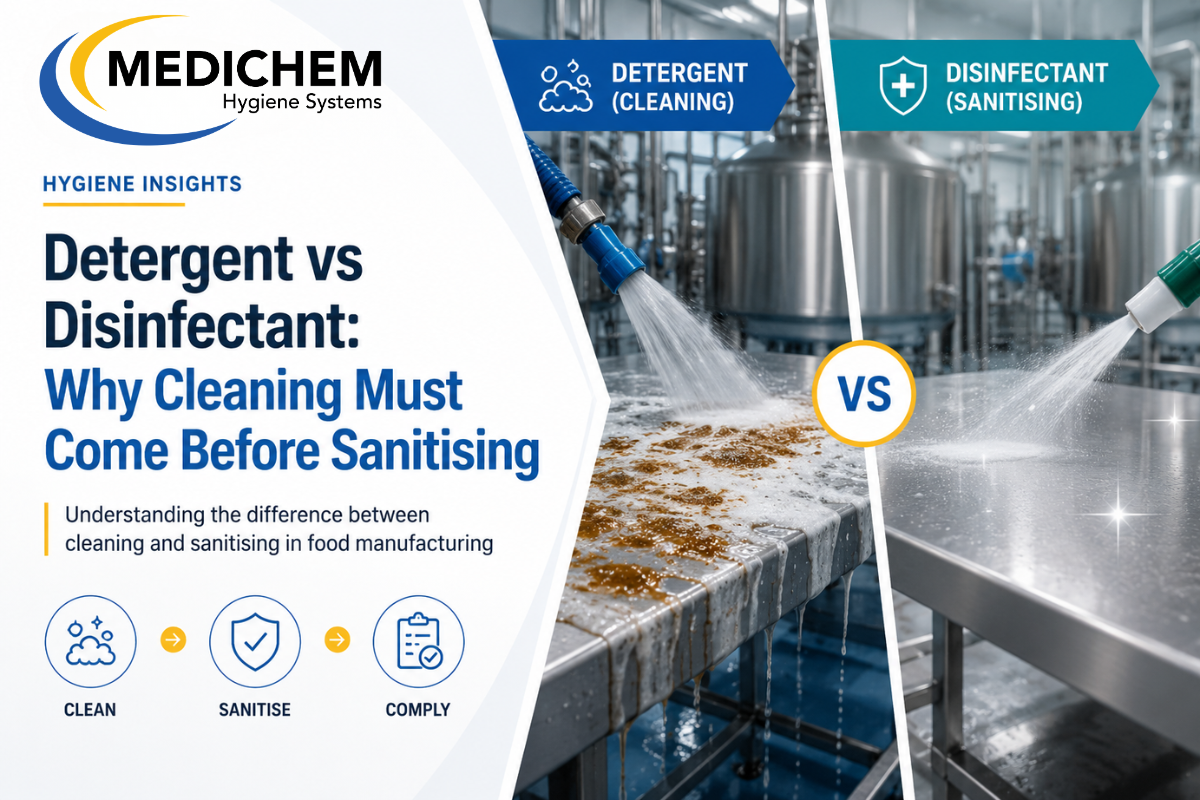
Detergent vs Disinfectant: Why Cleaning Must Come Before Sanitising
In food manufacturing and other hygiene-critical environments, the terms cleaning, disinfecting and sanitising are often used as if they mean the same thing.
They do not.
Understanding the difference between a detergent and a disinfectant is essential for building an effective hygiene system. If the wrong product is used, or if the correct process is not followed, surfaces may look clean while still carrying contamination risk.
One of the most important principles in hygiene is this:
You cannot reliably sanitise a dirty surface.
That is why proper cleaning must come before sanitising.
What is a detergent?
A detergent is a cleaning product designed to remove dirt, grease, oils, food residue, protein, sugar, soil and other contaminants from a surface.
Its main job is to lift and remove soil.
In a food factory, detergents are used to clean:
- production equipment,
- food-contact surfaces,
- floors,
- walls,
- crates and bins,
- drains,
- packaging areas,
- and general hard surfaces.
Different detergents are designed for different tasks. Some are low-foam, some are high-foam, some are heavy-duty degreasers, and some are suitable for more general cleaning.
What is a disinfectant or sanitiser?
A disinfectant or sanitiser is used to reduce microorganisms on a surface to an acceptable level, according to the product’s intended use and instructions.
Its main job is microbial control, not soil removal.
Disinfectants and sanitisers are typically used after the surface has already been cleaned, especially where hygiene control is important.
Depending on the product and application, they may be used on:
- food-contact surfaces,
- processing equipment,
- utensils,
- hand-contact points,
- walls and floors in production areas,
- and other surfaces where microbial control is required.
Why cleaning must come first
This is where many hygiene systems go wrong.
If a surface still has grease, food residue, protein or other soil on it, the disinfectant may not work effectively. Organic matter can interfere with the active ingredients and reduce contact between the disinfectant and the microorganisms on the surface.
In simple terms:
- the detergent removes the dirt,
- the disinfectant works on the cleaned surface.
If the cleaning step is poor, the disinfecting step becomes unreliable.
This is why staff should never assume that spraying a disinfectant onto a visibly dirty surface is enough.
A clean-looking surface is not always a hygienic surface
A surface may appear visually clean and still not be hygienically safe.
Likewise, a surface may have been sprayed with sanitiser and still not be properly sanitised if:
- it was not cleaned first,
- the dilution was incorrect,
- the contact time was too short,
- the product was used for the wrong application,
- or the surface was heavily soiled.
Visual appearance is important, but it is not the full measure of hygiene effectiveness.
The correct sequence
In most cases, the proper sequence is:
- Remove loose debris
- Clean using the correct detergent
- Rinse if required
- Apply the disinfectant or sanitiser
- Allow the required contact time
- Final rinse if the product instructions require it
The exact procedure may vary depending on the product, the surface, the application method and the site’s hygiene procedure, but the principle remains the same:
clean first, then sanitise.
Why detergents and disinfectants should not be confused
A common mistake is to assume that one product will do everything.
Some products may have both detergent and disinfectant properties, but even then, they must still be used correctly and according to their instructions. In many situations, especially where heavy soil is present, a separate cleaning step is still necessary before the disinfecting stage.
Confusing the roles of these products can lead to:
- reduced hygiene performance,
- poor audit outcomes,
- inconsistent cleaning results,
- wasted chemical usage,
- and increased contamination risk.
Choosing the right product for the right job is critical.
Practical examples in food manufacturing
A few simple examples help explain the difference:
Example 1: Greasy food-processing equipment
If a piece of equipment is coated in grease and food residue, a disinfectant alone is not enough. The soil must first be removed with a suitable detergent or degreaser before any sanitising step.
Example 2: Food-contact work surfaces
A work surface used during production should first be cleaned to remove product residue and soil. Once the surface is clean, a suitable sanitiser or disinfectant can be applied according to the correct dilution and contact time.
Example 3: Floors and drains
Floors and drains often carry heavy soil loads. Cleaning with the correct detergent is essential before applying any disinfecting chemistry. If soils are left behind, the disinfectant step will be less effective.
Contact time still matters
Even once a surface has been cleaned properly, the disinfectant or sanitiser still needs time to work.
If it is applied and immediately wiped off, rinsed off too quickly, or allowed to dry before the required time, the intended microbial reduction may not be achieved.
That is why contact time, correct dilution, and proper application are all just as important as the cleaning step.
Staff training is essential
Many hygiene issues are not caused by bad products, but by incorrect use.
Staff should understand:
- the difference between cleaning and disinfecting,
- when to use a detergent,
- when to use a disinfectant or sanitiser,
- the correct dilution rate,
- the required contact time,
- whether rinsing is needed,
- and the correct cleaning procedure for each area.
When staff understand the purpose behind each step, cleaning systems become much more effective and consistent.
Good hygiene is a system, not just a product
No single chemical can replace a proper hygiene system.
Effective cleaning depends on:
- selecting the correct product,
- following the correct sequence,
- using the right dilution,
- allowing adequate contact time,
- training staff properly,
- and verifying that the process is working.
That is why cleaning and sanitising should always be seen as part of a broader food safety system.
Final thought
Detergents and disinfectants do different jobs, and both are important.
A detergent helps remove the soil you can see. A disinfectant or sanitiser helps control the microorganisms you cannot see. But for sanitising to be effective, the cleaning step must be done properly first.
In food manufacturing, this is not just good practice. It is a key part of maintaining hygiene, supporting compliance, and protecting product quality.
At Medichem, we assist customers with practical hygiene guidance, product selection, and cleaning system support to help ensure that cleaning and sanitation programmes are effective, consistent and fit for purpose.
Built for compliance. Trusted for performance.


