
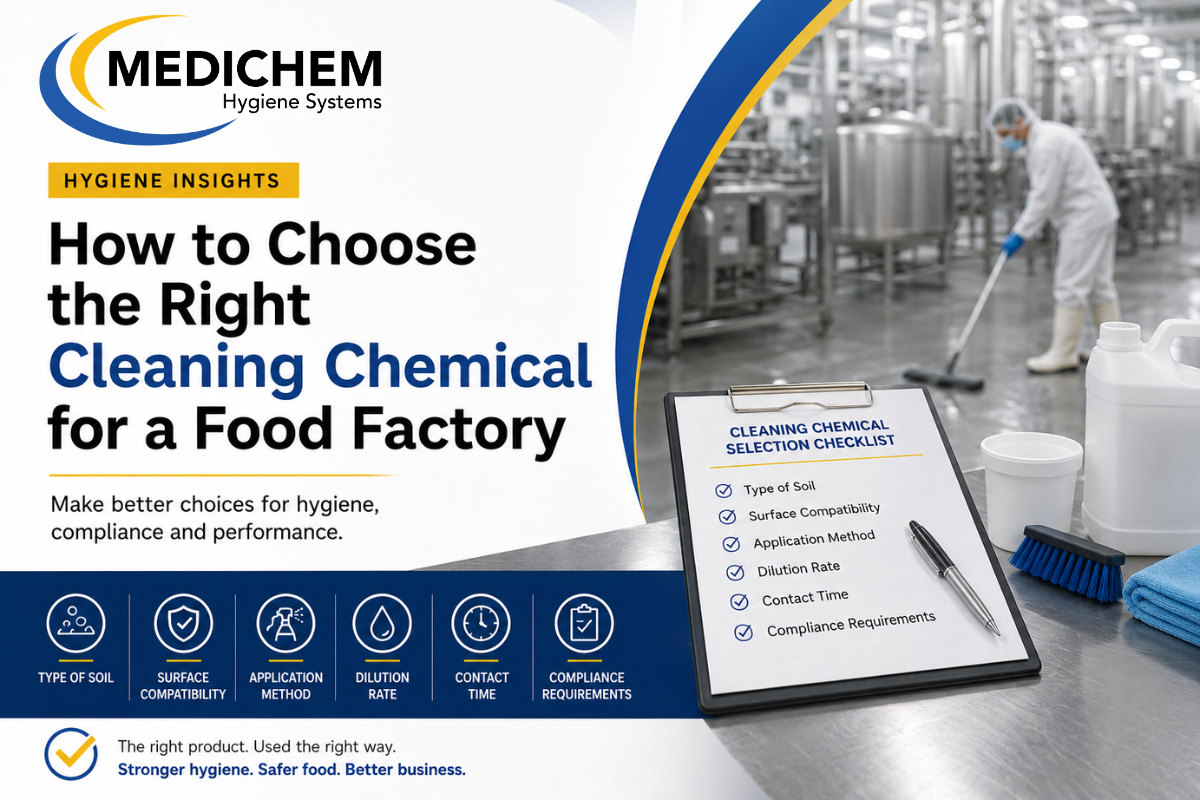
How to Choose the Right Cleaning Chemical for a Food Factory
Choosing the right cleaning chemical for a food factory is not as simple as buying a strong cleaner and expecting it to work everywhere.
Food manufacturing environments have different surfaces, soils, equipment, hygiene risks and audit requirements. A product that works well in one area may be unsuitable in another. The correct cleaning chemical should match the task, the surface, the type of soil, the cleaning method and the food safety requirement.
Using the wrong product can lead to poor cleaning results, wasted chemical, surface damage, staff safety risks, contamination concerns and audit problems.
A good chemical selection process helps ensure that cleaning is effective, practical and compliant.
1. Understand what needs to be cleaned
The first step is to identify the area or surface that needs cleaning.
A food factory may include:
-
food-contact surfaces,
-
processing equipment,
-
filling lines,
-
packing tables,
-
floors and drains,
-
walls and doors,
-
crates, bins and totes,
-
ovens, grills and smokehouses,
-
cold rooms,
-
staff facilities,
-
hand wash stations,
-
and chemical storage areas.
Each area may need a different cleaning approach. Food-contact surfaces usually require more controlled cleaning and sanitising procedures than general floors or external areas.
Before selecting a chemical, it is important to understand exactly where it will be used and what level of hygiene control is required.
2. Identify the type of soil
Cleaning chemicals should be selected according to the type of soil present.
Different soils require different chemistry.
For example:
Grease and oil may require an alkaline degreaser.
Protein and food residue may need a suitable detergent with good soil-lifting ability.
Sugar and carbohydrate residues may often be easier to remove with general detergent cleaning, depending on the process.
Mineral scale or hard-water deposits may require an acidic cleaner.
Carbonised deposits on grills, ovens or smokehouses may need a heavy-duty degreaser or carbon remover.
General dirt and light soil may only require a general-purpose detergent.
If the chemical does not match the soil, the cleaning process becomes harder, slower and less reliable.
3. Match the product to the surface
The cleaning chemical must also be suitable for the surface being cleaned.
Food factories may have stainless steel, plastic, rubber, aluminium, painted surfaces, coated floors, concrete, tiles and other materials.
A product that is suitable for stainless steel may not be suitable for aluminium or painted surfaces. Strong alkaline cleaners, acidic cleaners and chlorine-based products can all cause problems if used incorrectly or on incompatible surfaces.
Before choosing a product, check whether it is suitable for the surface and whether there are any restrictions, rinse requirements or compatibility concerns.
This is especially important for equipment, soft metals, seals, gaskets and coated surfaces.
4. Consider the cleaning method
The product must also suit the way it will be applied.
Common cleaning methods in food factories include:
-
manual cleaning,
-
spray-and-wipe cleaning,
-
foam cleaning,
-
soaking,
-
crate or bin washing,
-
CIP cleaning,
-
floor scrubbing,
-
pressure washing,
-
and fogging or misting where applicable.
A high-foam product may be excellent for walls, floors and open plant cleaning, but unsuitable for a CIP system. A low-foam product may be ideal for mechanical cleaning or closed systems, but less effective where visual foam coverage is needed.
The application method matters. The product must fit the cleaning equipment and the site procedure.
5. Separate cleaning from sanitising
One of the most important points in food factory hygiene is that cleaning and sanitising are not the same thing.
A detergent removes dirt, grease, food residue and soil.
A sanitiser or disinfectant reduces microorganisms to an acceptable level, according to the product’s intended use and instructions.
In most cases, the surface must be cleaned first before it is sanitised. Applying a sanitiser to a dirty surface may reduce its effectiveness because soil can interfere with the active ingredients and prevent proper surface contact.
When choosing chemicals, make sure the cleaning programme includes both the cleaning step and the sanitising step where required.
6. Check dilution rates and cost-in-use
The cheapest product per litre is not always the cheapest product to use.
A more concentrated product may have a higher purchase price but a lower cost-in-use if it is diluted correctly and performs well. A cheaper product may end up costing more if staff need to use too much, repeat the cleaning process, or spend extra time scrubbing.
When comparing products, consider:
-
dilution rate,
-
cleaning performance,
-
labour time,
-
water usage,
-
application method,
-
wastage,
-
and consistency of results.
Correct dilution control is important. Overdosing wastes money and may create residue or safety issues. Underdosing can result in poor cleaning and hygiene failure.
7. Confirm contact time and rinse requirements
Many products require a specific contact time to work properly.
This applies especially to sanitisers and disinfectants, but contact time can also matter for heavy-duty cleaners and degreasers.
If a product is applied and rinsed off too quickly, it may not perform as intended.
The cleaning procedure should clearly state:
-
how the product is diluted,
-
how it is applied,
-
how long it must remain on the surface,
-
whether it must be scrubbed,
-
whether it must be rinsed,
-
and when the surface may be used again.
Rinse requirements are especially important in food factories, particularly where chemicals are used on food-contact surfaces.
8. Consider food safety and audit requirements
Chemical selection should support the site’s food safety system.
Food manufacturers often need cleaning chemicals that are supported by proper documentation, including:
-
Safety Data Sheets,
-
Technical Data Sheets,
-
product labels,
-
usage instructions,
-
dilution guidance,
-
NSF registration details where applicable,
-
and training support.
During audits, the site may be asked to show that chemicals are suitable for their intended use, stored correctly, labelled correctly and included in approved cleaning procedures.
A good supplier should be able to provide the documentation needed to support the hygiene programme.
9. Consider staff safety
Cleaning chemicals must be effective, but they must also be used safely.
Before choosing a product, consider:
-
PPE requirements,
-
handling risks,
-
odour,
-
ventilation,
-
chemical compatibility,
-
storage requirements,
-
spill procedures,
-
and staff training needs.
Staff should understand how to dilute, apply, store and handle the product safely.
Products should never be mixed unless the procedure specifically allows it. Mixing chemicals incorrectly can be dangerous and may release harmful fumes or cause reactions.
10. Choose products that fit the site, not just the catalogue
A cleaning chemical should not be selected in isolation. It should fit into the factory’s full cleaning and sanitation programme.
Before approving a product, ask:
-
What area will it be used in?
-
What soil does it need to remove?
-
What surface will it be used on?
-
What application method will staff use?
-
Is it a cleaner, sanitiser, disinfectant or specialist product?
-
What dilution is required?
-
What is the contact time?
-
Does it require rinsing?
-
Is documentation available?
-
Are staff trained to use it correctly?
-
Does it support audit and compliance requirements?
The right product is the one that works in the real conditions of the factory.
Final thought
Choosing the right cleaning chemical for a food factory requires more than looking at price or product strength.
The product must match the soil, surface, application method, hygiene requirement and site procedure. It must also be supported by correct documentation, staff training and safe handling practices.
When the right product is used in the right way, cleaning becomes more consistent, hygiene systems become stronger, and food safety audits become easier to support.
At Medichem, we assist food industry customers with product selection, cleaning schedule guidance, staff training support and documentation. Our range includes NSF registered cleaning and hygiene products suitable for use in food industry environments when used according to their registered category and instructions.
Built for compliance. Trusted for performance.


